


Samella Lewis Print Club
Samella Lewis Print Club
Couldn't load pickup availability
A twelve-month collecting program honoring the art and legacy of Dr. Samella Lewis.
Receive one estate-authorized, numbered fine art print each month, beginning with Swamp Diva and followed by Boy on a Bench.
Exactly 500 Print Club allocations are available. The first 500 numbers in every 1,000-print edition are reserved for Print Club members. Your enrollment secures the next available collector number, and that same number is held for you across all twelve prints.
Choose how you would like to join:
Pay monthly: $150 per month for up to twelve monthly shipments. See our cancellation policy.
Pay in full: $1,650 once for the complete twelve-print collection—a savings of $150.
Whichever option you choose, prints are released and shipped one at a time each month. For U.S. Print Club orders, Standard shipping is free and Express shipping is $15. International shipping availability and charges are shown at checkout.
The remaining 500 prints in each edition—numbers 501 through 1,000—will be released individually to the public at $225 per print. Print Club is the only way to secure the complete twelve-print series at the member price while keeping one consistent collector number across the collection.
The first shipment is planned for the first week of November 2026. All sales are final except for damaged, incorrect, or confirmed lost-in-transit items, as described in the refund policy.
Share


A Different Way to Collect Samella Lewis
The Print Club brings twelve Samella Lewis works together in a fixed monthly sequence. Every member begins with Swamp Diva, followed by Boy on a Bench, then receives one print each month. The same collector number is held across the full set, creating one collection that unfolds over the year.
The Collection, at a Glance
01 Swamp Diva · 02 Boy on a Bench · 03 Upstate New York Landscape · 04 Migrants · 05 Massai · 06 Confrontation · 07 Family · 08 Waterfront · 09 Children’s Game · 10 Home Sweet Home · 11 Field · 12 I See You. Every member follows the fixed sequence, beginning with Swamp Diva.
Museum and Institutional History
Several works in this collection are represented in museum collections. The Museum of Modern Art holds Lewis’s Migrants (1968); the National Gallery of Art holds a related 2005 edition of Boy on a Bench, while the Philadelphia Museum of Art catalogs a 2007 version; the Smithsonian’s National Museum of African American History and Culture holds Confrontation (1969); and the Los Angeles County Museum of Art includes Children’s Game (1968/1982) in its collection.
About Dr. Samella Lewis
Dr. Samella Lewis (1923–2022) was an artist, art historian, curator, educator, filmmaker, publisher, and institution builder. She studied with Elizabeth Catlett and Charles White, became the first African American woman to earn a doctorate in art history, founded the Museum of African American Art in Los Angeles, co-edited the landmark Black Artists on Art volumes, and spent her life expanding how Black art was studied, preserved, published, and seen.
About Contemporary Crafts
Dr. Samella Lewis used Contemporary Crafts, Inc. to publish and distribute work by Black artists. Through publishing, teaching, scholarship, and institution building, she expanded how Black art could be documented, encountered, and collected. The Print Club continues that publishing legacy with twelve estate-authorized prints issued directly by the archive.
What You Receive
Twelve estate-authorized fine art prints issued monthly. Most rectangular works will be produced at approximately 12 × 18 inches; square compositions may use a more appropriate square format. Orientation follows each original composition. Paper weight, tone, and surface will be selected individually according to what best carries each image. Every print is individually numbered with the same collector number across the set and accompanied by archive authentication. Prints are not hand-signed by Dr. Lewis. Framing is not included.
Enrollment and Edition Rules
Enrollment is limited to exactly 500 Print Club allocations. The first 500 numbers in each 1,000-print edition—numbers 1 through 500—are reserved for Print Club members. Your first print is Swamp Diva, regardless of the image that introduced you to the club. Your assigned number remains attached to your collection for the full twelve-print sequence. The remaining 500 prints in each edition—numbers 501 through 1,000—will be released individually to the public at $225 per print. Print Club pricing is available only through the club.
Shipping, Care, and Claims
The first shipment is scheduled for the first week of November 2026. One print ships each month in protective archival packaging; paid-in-full collectors receive the same monthly release experience. For U.S. Print Club orders, Standard shipping is free and Express shipping is $15. International shipping availability and charges are shown at checkout. All sales are final except for an item that arrives damaged, is incorrect, or is confirmed lost in transit. Contact membership@contemporarycraftsinc.com within seven days of delivery—or, for a missing package, within seven days of the carrier’s expected delivery date—with your order number and, when applicable, photographs of the packaging and print. Store prints flat or frame them with archival materials, away from direct sunlight, moisture, and extreme temperature changes.
The Twelve Works
01 — Swamp Diva
Swamp Diva (2005) draws on Lewis’s upbringing in New Orleans and her family’s deep roots in Louisiana’s bayou country. She once said that the meaningful symbols of her Louisiana childhood could provide material for paintings for the rest of her life. Here, a commanding face emerges through saturated red, yellow, green, and deep blue, with visible brushstrokes keeping the surface alive. The title joins the figure’s self-possession to the swamp and bayou landscape that shaped Lewis’s earliest memories.
02 — Boy on a Bench
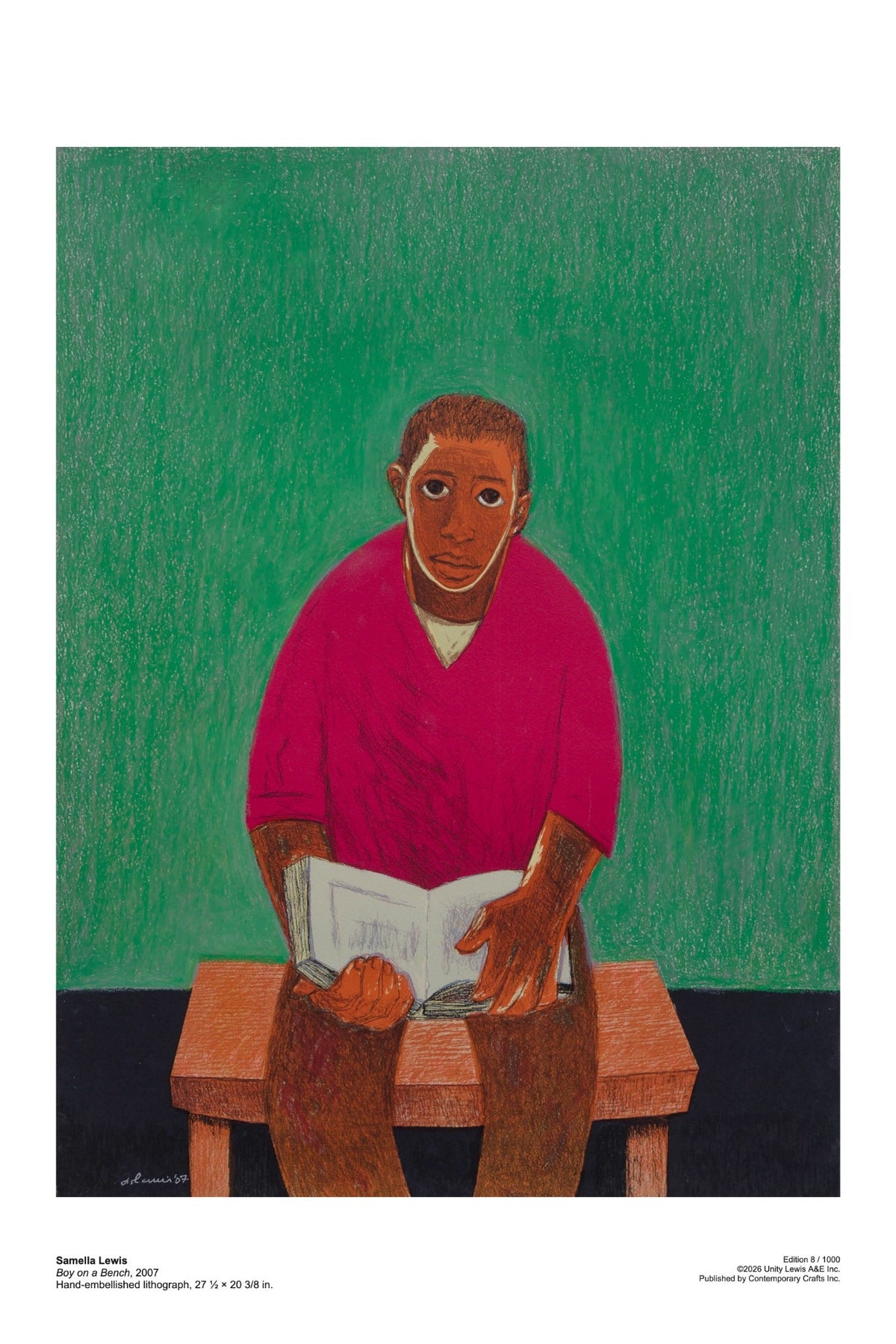
The 2007 hand-embellished impression shows a boy seated on a bench, absorbed in an open book. Lewis’s lifelong work as an art educator gives the scene context: study becomes a form of possibility. Against the history of restrictions and violence surrounding Black literacy, this ordinary act of reading carries particular weight.
03 — Upstate New York Landscape
The work began as a 1958 oil painting on wood panel. Nearly four decades later, Lewis revisited it in a color screenprint titled Landscape. Long horizontal bands of red, orange, green, and blue turn the upstate New York view into a composition shaped by color and rhythm.
04 — Migrants
Lewis’s 1968 linocut portrays seven migrants seated closely together, with sharply cut marks defining their faces, clothing, and individual postures. Lewis later recalled seeing the subjects—bean pickers—in the back of a bus. Their compressed arrangement gives the group a shared weight while preserving each person’s distinct presence; among them, a woman with crossed arms meets the viewer directly.
05 — Massai
Massai (2005) is a close-up, highly abstracted portrait of a Maasai warrior. Broad red, yellow, blue, and green strokes reduce the face to color and structure while keeping its gaze and expression vivid. The tight crop holds the viewer at close range, face to face with the subject.
06 — Confrontation
In Confrontation (1969), black-and-white forms press against and move through one another. LACMA connects the work’s stark contrast with the struggle for civil rights. The composition can also be read as one continuous, fluid gesture, turning confrontation into an exchange of pressure, resistance, and movement.
07 — Family
The Hammer Museum describes Family (1967) as an abstract linocut of three upright, leaf-like forms. In black and white, carved contours and open space make their closeness the structure of the image: distinct forms stand together, suggesting kinship through proximity.
08 — Waterfront
In Waterfront (2016), a broad tree anchors the foreground as sailboats drift across a deep band of blue water toward a distant shore. The composition balances rootedness and motion: the weight of the tree holds the eye while the open water carries it outward. Lewis turns an ordinary shoreline into a place of stillness, distance, and possibility.
09 — Children’s Game
Lewis drew on childhood memories of Ring Around the Rosie for Children’s Game (1968/1982), where linked hands turn the circle into a rhythm of movement. LACMA describes its mood as joy and hope in togetherness. The game depends on each child staying connected to the group—a memory of play and community.
10 — Home Sweet Home
In Home Sweet Home (1968), a seated figure reads by candlelight. The small flame creates an intimate space around the reader, turning the act of reading into one of quiet comfort and absorption. The title reinforces that sense of refuge: home as a place where the figure can withdraw into the private world of a book.
11 — Field
Field (1968) sets a solitary figure beneath an enormous sun, one arm raised with a clenched fist. A Hammer Museum teaching guide connects the image with histories of enslaved and migrant labor, and the raised fist with Black Power-era solidarity. The stark linocut makes the gesture carry the composition’s political force.
12 — I See You
I See You (2005) is a linocut portrait of an anonymous, androgynous face. Scripps College describes its chiseled, linear quality; dense carved marks and stark contrast make the eyes especially insistent. Looking becomes an encounter among sitter, artist, and viewer, with the figure seeming to return the viewer’s gaze.